
 Author Esenceweb
Website Development Guide for Businesses
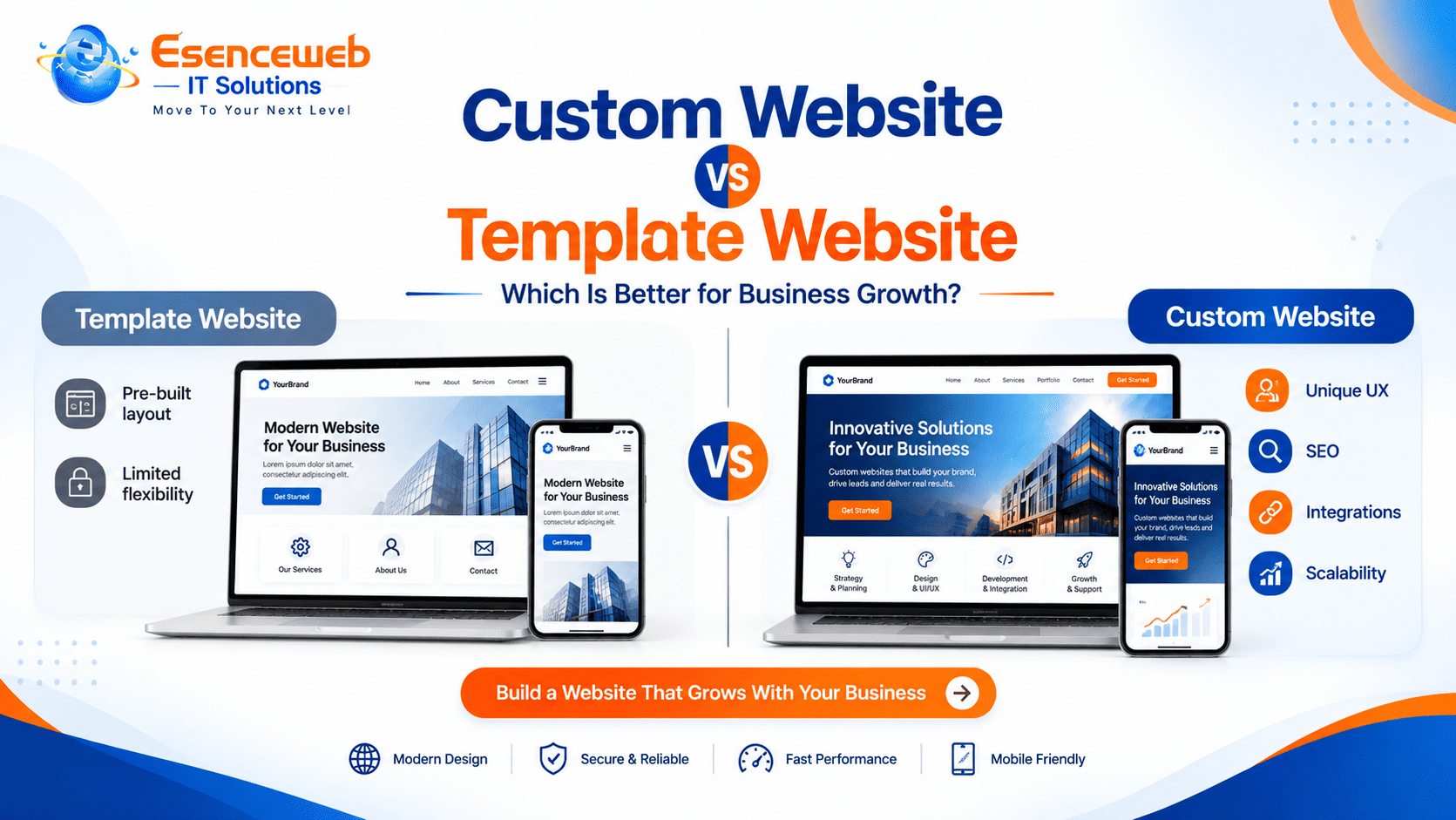
Choosing between a custom website and a pre-designed template can significantly affect your online visibility, customer experience, lead generation, scalability and long-term digital growth. This guide explains the differences so you can choose the right website development approach for your business.
Custom Website Development vs Template Website: What Should a Business Choose?
Your website is often the first interaction a potential customer has with your business. It can influence whether someone contacts your sales team, requests a quotation, purchases a product or moves to a competitor.
That makes website development more than a design decision. It is a business investment that should support branding, search engine visibility, mobile users, customer acquisition and future growth.
Businesses generally consider two options: a template-based website or a custom-developed website.
Template websites can offer a relatively quick and economical route to an online presence. Custom development, on the other hand, allows the website to be designed around specific business processes, customers, integrations and growth objectives.
The right choice depends on your requirements rather than simply the initial development price.
What Is a Template Website?
A template website uses a pre-built design and structure created for a broad range of users. Businesses can generally customize elements such as their logo, images, colors, content and products without developing every component from scratch.
Template-based solutions are often suitable for businesses that need a relatively simple website and want to launch quickly.
Advantages of Template Websites
- Faster initial website launch
- Lower starting development investment
- Pre-designed layouts
- Large selection of visual themes
- Suitable for straightforward informational websites
- Often easier for non-technical users to manage
However, businesses should also consider customization limits, performance requirements, plugin dependencies, long-term scalability and unique functionality before selecting a template.
What Is Custom Website Development?
Custom website development involves designing and developing a website specifically around the requirements of a business. Instead of adapting an existing theme to your workflow, the architecture, interface and functionality can be planned around your customers and business processes.
A custom website can be created for anything from a professional corporate website to a sophisticated business application.
Typical Custom Website Features
- Unique user interface and user experience
- Responsive and mobile-first layouts
- Custom enquiry and lead forms
- Customer dashboards
- Membership functionality
- Online booking systems
- Payment gateway integration
- CRM integration
- ERP integration
- Third-party API integration
- Custom ecommerce functionality
- Business automation workflows
Custom Website vs Template Website: Detailed Comparison
| Factor | Custom Website | Template Website |
|---|---|---|
| Design flexibility | Very high | Limited by template structure |
| Brand differentiation | Highly customizable | May resemble other websites |
| Development speed | Usually requires more planning | Generally faster to launch |
| Initial investment | Usually higher | Usually lower |
| Scalability | Excellent | Depends on platform and theme |
| Business integrations | Highly flexible | May depend on plugins or available integrations |
| SEO control | High technical control | Depends on platform and configuration |
| Performance optimization | Can be planned around requirements | Depends heavily on theme and configuration |
| Complex functionality | Highly suitable | Can become difficult or plugin-dependent |
1. Design and Brand Identity
Your website should communicate what makes your company different. Template websites provide an existing visual framework, which can speed up development but may restrict the uniqueness of the final experience.
Custom website development gives businesses more control over layouts, navigation, typography, visual hierarchy, animations, conversion sections and brand presentation.
This can be particularly valuable for companies competing in crowded markets where a generic digital presence may not communicate enough differentiation.
2. SEO-Friendly Website Development
Businesses investing in organic search need a website that provides a strong technical foundation for SEO.
Important areas include:
- Logical website architecture
- Clean URLs
- Fast-loading pages
- Mobile responsiveness
- Search-friendly content structure
- Metadata controls
- Canonical URLs
- Internal linking
- Image optimization
- Structured data where appropriate
- XML sitemap
Both custom and template websites can be optimized for search, but the level of technical control can vary considerably depending on the platform, theme and implementation.
If your objective is to compete for searches such as "website development company Pune", "custom website development Pune" or industry-specific business searches, SEO should be considered during website architecture and development rather than added as an afterthought.
3. Website Speed and Performance
Performance influences user experience, especially when people access your website through mobile networks.
Some templates can include functionality that a particular business never uses. Depending on implementation, unnecessary scripts, plugins, animations or large assets can contribute to performance issues.
A custom website can be engineered around the functionality actually required by your organization.
Performance planning can include image optimization, efficient code, caching, database optimization, script management and responsive asset delivery.
4. Mobile-First Website Experience
Mobile users should be considered from the beginning of the website planning process.
A professional responsive website should provide convenient navigation, readable content, accessible buttons, fast loading, simple forms and clear conversion paths across smartphones and tablets.
For local businesses, mobile optimization can be particularly important because prospective customers may discover a company through a local search and immediately want to call, message or submit an enquiry.
5. Scalability for Business Growth
A website that works today may not satisfy your business two or three years from now.
Growing companies may eventually require:
- Customer login areas
- Dealer or distributor portals
- Advanced product catalogues
- Online payments
- CRM connectivity
- ERP connectivity
- Inventory systems
- Booking modules
- Subscription functionality
- Business dashboards
- Mobile applications
- External APIs
Custom development can provide a stronger foundation when these requirements are part of the company's long-term roadmap.
6. CRM, ERP and Third-Party Integration
Modern business websites frequently need to exchange information with other software.
For example:
Website ? CRM ? Sales Team
or
Website ? ERP ? Inventory ? Order Processing
or
Website ? Payment Gateway ? Order Management
A custom web development project can be designed around these workflows and the organization's specific operational needs.
7. Lead Generation and Conversion Optimization
A business website should have a measurable purpose.
For a B2B company, the desired journey could be:
Google Search ? Landing Page ? Requirement Form ? Sales Team
For ecommerce:
Search ? Product ? Cart ? Checkout ? Purchase
For a service business:
Search ? Service Page ? WhatsApp/Call ? Consultation
Custom development makes it easier to design pages around specific conversion journeys instead of simply placing generic content inside a pre-designed layout.
8. Security and Maintenance
Website security should be considered regardless of whether you select a template or custom solution.
Businesses handling customer accounts, payments, documents or sensitive operational information should pay particular attention to authentication, authorization, input validation, secure APIs, access control, database security and hosting configuration.
Template-based projects can involve multiple themes, plugins and external components. Their maintenance requirements should be assessed before implementation.
Custom development allows the technical architecture to be controlled more closely, although ongoing updates, monitoring and security maintenance remain essential.
9. Custom Website Development Cost vs Template Cost
A template website generally requires a smaller initial investment because the underlying design and functionality already exist.
Custom development involves additional activities such as:
- Requirement analysis
- Information architecture
- UI/UX design
- Custom development
- Database design
- API development
- Testing
- Security implementation
- Performance optimization
Therefore, comparing only the initial quotation can be misleading.
Businesses should consider the total value of the website, including its ability to generate leads, support operations, integrate with existing systems and scale over time.
When Is a Template Website a Good Choice?
A template may be appropriate if your business needs a simple website with limited functionality.
Examples include:
- Basic company profile websites
- Personal portfolios
- Simple informational websites
- Small websites with limited pages
- Projects requiring a very fast launch
- Businesses with minimal customization requirements
When Should You Choose Custom Website Development?
Custom development becomes more attractive when the website is expected to become an important part of business operations or customer acquisition.
- You need a unique user experience
- Your website is a major lead-generation channel
- You require advanced SEO control
- You need CRM or ERP integration
- You require custom ecommerce functionality
- You need customer or employee dashboards
- You want business process automation
- You expect significant future growth
- You require industry-specific functionality
Custom Website Development for Different Industries
Manufacturing Businesses
Manufacturers may require product catalogues, quotation requests, dealer portals, customer accounts, ERP integration and lead management.
Logistics Companies
Logistics organizations may need shipment tracking, booking workflows, customer portals, fleet-related integrations and automated notifications.
Healthcare Organizations
Healthcare businesses may require appointment systems, doctor profiles, patient registration, online consultations and integrations with internal systems.
Real Estate Businesses
Property businesses can benefit from advanced property search, filters, lead capture, agent dashboards and CRM connectivity.
Ecommerce Businesses
Growing online stores may need customized product management, payment processing, inventory synchronization, shipping integrations and customer account functionality.
What About SEO: Can Template Websites Rank on Google?
Yes. A template website can rank in search engines.
Choosing a custom website does not automatically guarantee higher Google rankings.
Search visibility depends on many factors, including relevance, content quality, technical implementation, site performance, mobile usability, internal linking, authority, competition and search intent.
The advantage of a well-planned custom website is greater control over the technical and content architecture when SEO is a major business objective.
How to Choose a Website Development Company in Pune
If you are searching for a website development company in Pune, don't compare agencies only by their quoted price.
Before selecting a development partner, evaluate:
- Relevant portfolio
- Industry experience
- Technical capabilities
- UI/UX expertise
- Mobile development approach
- SEO understanding
- API and third-party integrations
- Security practices
- Post-launch support
- Communication process
- Project documentation
- Ability to understand your business requirements
The best development partner should understand both technology and the business problem the website is expected to solve.
Why Choose Esenceweb for Custom Website Development?
At Esenceweb, we specialize in custom website development and business-focused web solutions designed around specific business requirements rather than forcing every company into the same website structure.
Our development approach can combine business strategy, responsive UI/UX, SEO-friendly architecture, performance, integrations and scalable technology.
We work with startups, SMEs and established organizations that need professional websites and custom web applications for different business requirements.
Depending on project requirements, solutions can include corporate websites, ecommerce platforms, customer portals, business applications, CRM-connected websites, ERP integrations and customized web systems.
For businesses searching for a custom web development company in Pune, the objective should not simply be to launch another website. The objective should be to build a digital asset that supports visibility, customer experience and business growth.
Custom Website vs Template Website: Final Verdict
There is no universal answer for every business.
A template website can be a sensible choice when your requirements are straightforward, your budget is limited and you need a basic online presence quickly.
Custom website development becomes more valuable when you need unique branding, advanced functionality, strong scalability, integrations, sophisticated lead-generation journeys or a website that can evolve with your business.
Instead of asking only, "Which option is cheaper?", consider asking:
"Which website approach will create the most value for my business over the next three to five years?"
That question can lead to a much better technology and investment decision.
Ready to Build a Website That Generates Business?
Discuss your requirements with Esenceweb and find out whether a custom website, template solution or another approach is the right fit for your business.
Get a professional website strategy focused on your business goals, customers, SEO and long-term growth.
Serving businesses in Pune, Maharashtra and across India.
Request a Website ConsultationFrequently Asked Questions
Is custom website development better than a template website?
It depends on your requirements. Custom development is generally better for businesses requiring unique functionality, scalability, integrations and greater control. Templates can work well for simple websites with straightforward needs.
Is a custom website better for SEO?
Custom development can provide greater technical flexibility for SEO, but customization alone does not guarantee rankings. Content quality, relevance, technical SEO, performance, authority and search intent all matter.
Is a template website cheaper than custom development?
A template website generally has a lower initial development cost. However, the overall business value should also consider customization, maintenance, integrations, future development and lead-generation performance.
Can a custom website be mobile responsive?
Yes. A custom website can be designed and developed with a responsive or mobile-first approach so that the experience adapts to smartphones, tablets and desktop devices.
Can custom websites integrate with CRM and ERP systems?
Yes. Depending on the available APIs and technical architecture, custom websites can integrate with CRM, ERP, payment gateways, inventory systems and other business applications.
How do I choose a website development company in Pune?
Review the company's portfolio, technical expertise, development methodology, relevant industry experience, integration capabilities, SEO knowledge, support process and ability to understand your business requirements before making a decision.









.png)
_(1).jpg)
_(2).jpg)
.jpg)

_(1).jpg)

.jpg)
.jpg)
.jpg)
.jpg)
.jpg)


.jpg)
_(1).jpg)
.jpg)
.jpg)


_(1).png)

.png)
1.png)







4.png)


0 Replies to “Custom Website Development Vs Template Website?”
Leave a Reply
Your email address will not be published.