
 Author Esenceweb
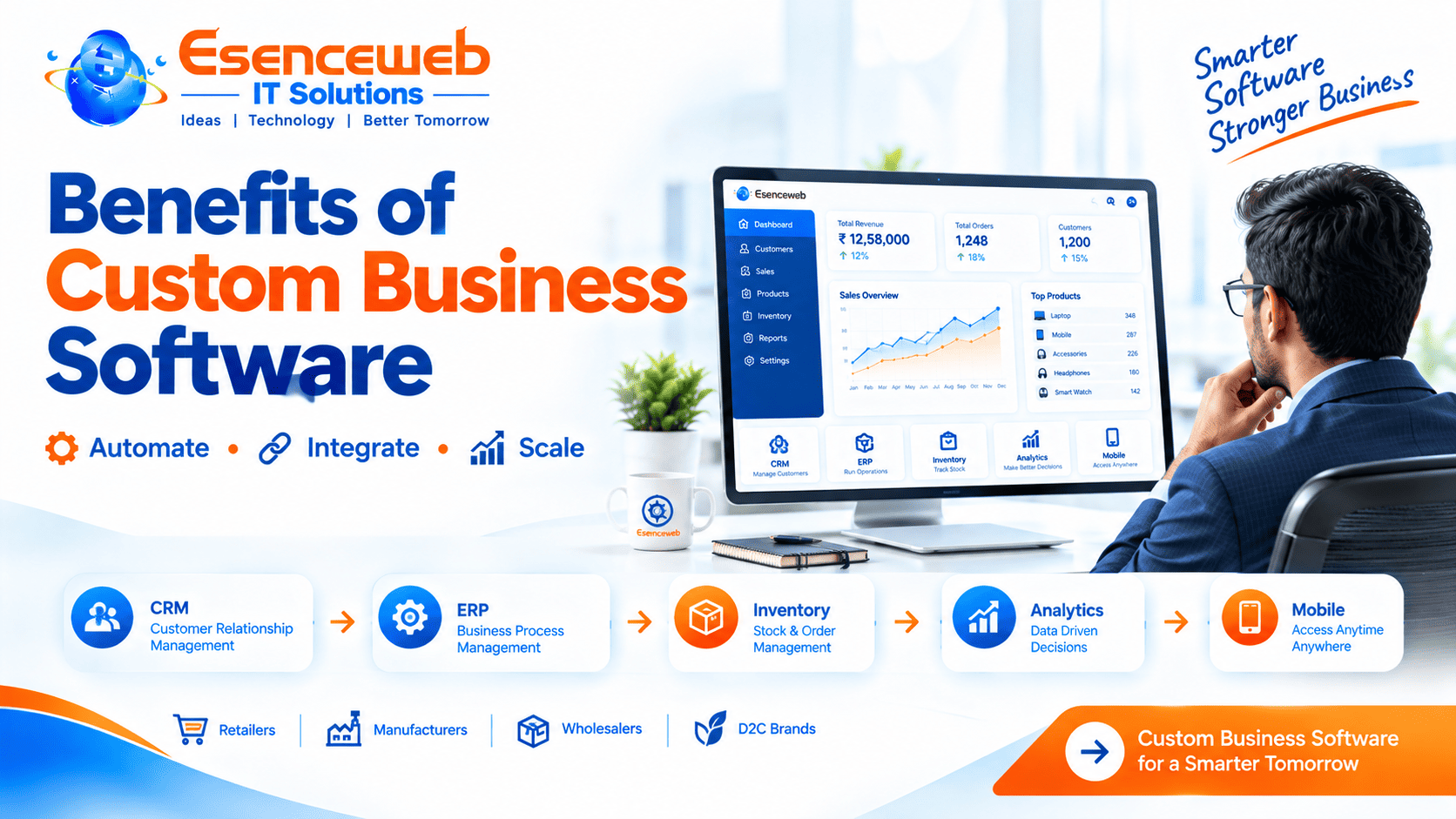
Growing a business is exciting, but expansion often brings operational challenges. More customers, employees, orders, products and transactions can make existing processes difficult to manage. Spreadsheets, disconnected applications and repetitive manual work may no longer provide the efficiency or visibility your organization needs.
This is where custom business software can provide practical value. Designed around your organization's workflows, users and business requirements, custom software can help connect departments, automate repetitive activities, improve reporting and support future expansion.
For businesses evaluating a custom software development company in Pune or India, the objective should be more than building an application. It should be solving measurable business problems through reliable, secure and scalable technology.
What Is Custom Business Software?
Custom business software is a digital application developed for the specific operational requirements of an organization. Instead of relying entirely on predefined features, businesses can commission software that reflects their actual processes, responsibilities, reporting needs and integrations.
Depending on the project, a custom business application may include:
- Sales, quotation and billing management
- Customer relationship management (CRM)
- Enterprise resource planning (ERP)
- Inventory and warehouse management
- Purchase and supplier management
- Production and manufacturing workflows
- Logistics, fleet and delivery management
- Employee access, approvals and task management
- Management dashboards and business reports
- Payment gateways and third-party API integrations
- Responsive web applications and mobile applications
For example, a distributor may need sales counters, customer credit tracking, billing, payment records and consolidated daily reports in one system. A customized application can bring these activities together according to the company's approved workflow.
Why Growing Businesses Need Custom Software
A process that works for a small team may become inefficient when transaction volumes increase. Employees might maintain separate spreadsheets, enter information into several applications or depend on managers to prepare reports manually.
Common warning signs include:
- Repeated data entry across departments
- Inconsistent customer or product records
- Slow approvals and delayed order processing
- Limited visibility into sales and inventory
- Difficulty preparing accurate management reports
- Disconnected accounting, CRM and operational systems
- Business processes that depend on individual employees
- Software that cannot accommodate specialized workflows
Custom software is worth evaluating when these problems materially affect productivity, service quality or management decisions. The first step is to identify the underlying problem and determine whether customization offers better value than configuring an existing product.
12 Major Benefits of Custom Business Software
1. Automate Repetitive Business Processes
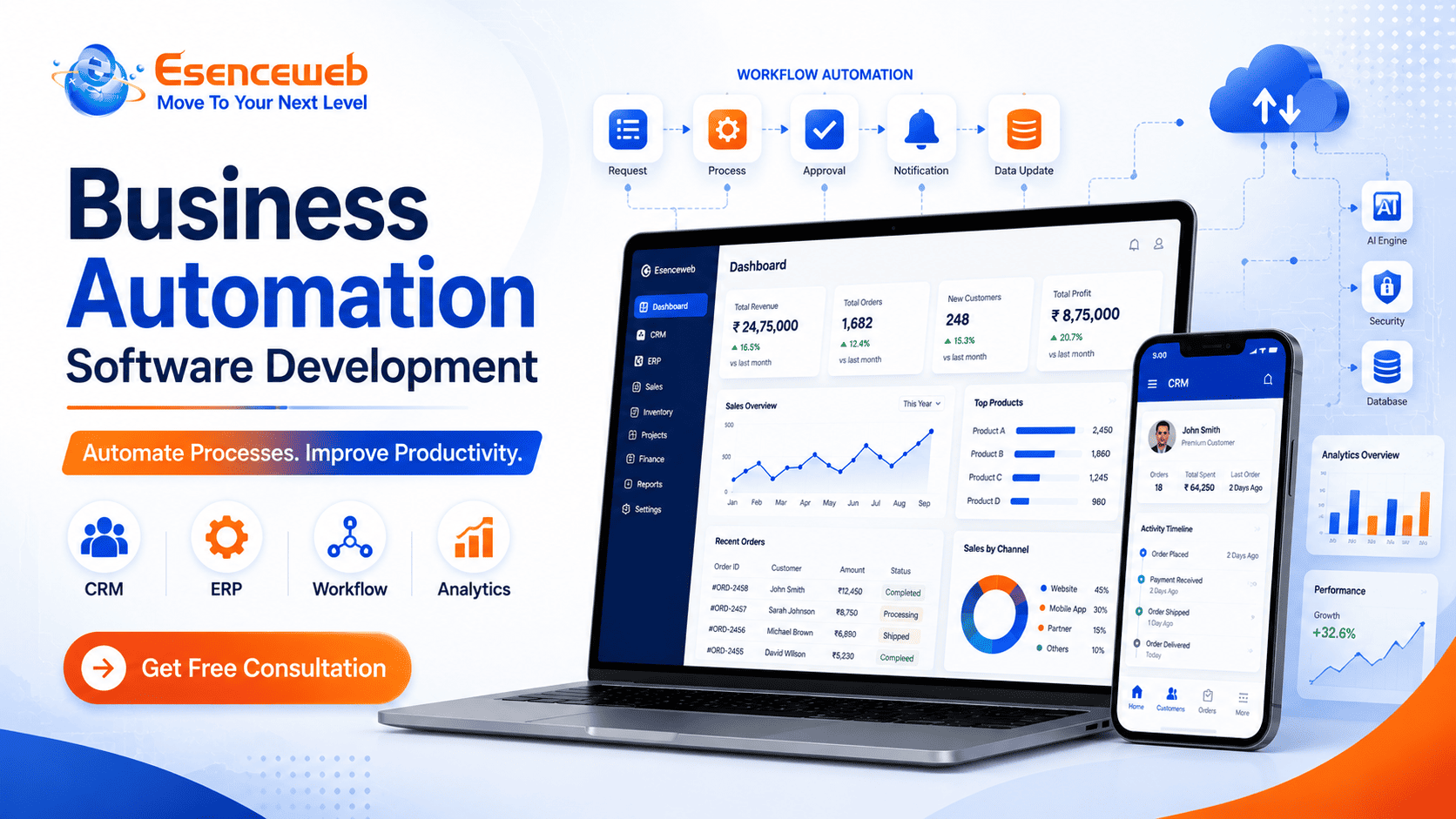
Repetitive administrative work can consume time that employees could otherwise spend on customers, operations and business improvement. Custom business process automation software can reduce unnecessary manual steps in suitable workflows.
Depending on the requirements, automation may cover:
- Invoice and document generation
- Sales order processing
- Purchase approval requests
- Customer follow-up reminders
- Stock updates and low-stock alerts
- Delivery status notifications
- Routine reports and scheduled summaries
Consider an order-processing workflow. When an authorized employee confirms an order, the application can update the relevant order status, initiate the next approval step and make the transaction available to reporting modules. Additional actions, such as invoice generation or inventory updates, can be included where the business rules allow them.
The benefit is a more consistent workflow with fewer unnecessary handoffs. The actual time saved depends on the process, implementation quality and employee adoption.
2. Improve Operational Efficiency
Employees work more efficiently when they can access the information and functions required for their roles in one connected application.
A custom business management system can bring customer records, transactions, approvals, tasks and reports into a structured workflow. This reduces the need to search through different files and applications to understand the status of an activity.
For example, a sales manager may be able to review orders, outstanding payments and team performance from a single dashboard instead of requesting separate spreadsheets from multiple employees.
3. Reduce Avoidable Data-Entry Errors
Incorrect quantities, duplicate customer records, missing fields and inconsistent calculations can create operational problems. Custom software can introduce validation rules, standardized forms, controlled access and automated calculations to reduce these risks.
When connected modules reuse verified information, employees may not need to enter the same details repeatedly. However, software cannot eliminate every error. Data quality checks, testing, staff training and appropriate review processes remain important.
4. Access Timely Business Reports and Dashboards
Business owners need useful information to make informed decisions. Custom reporting software can organize operational data into dashboards that match the company's management requirements.
Possible reports include:
- Daily and monthly sales summaries
- Order status and pending deliveries
- Outstanding customer payments
- Inventory and stock movement
- Purchase and supplier performance
- Employee or branch performance
- Project progress and task status
Reports should use defined business rules and reliable source data. Where information is updated periodically rather than continuously, the dashboard should clearly reflect its update frequency.
5. Build Workflows Around Your Business
Two companies in the same industry can operate differently. Their approval hierarchies, pricing rules, customer categories, delivery processes and reporting requirements may not match.
Ready-made software can be suitable when its standard functionality meets these requirements. Custom software development becomes more attractive when the organization needs specialized workflows that existing products cannot support adequately.
A tailored application can be planned around actual business rules, including different user permissions, approval levels, transaction limits, branch operations and industry-specific forms.
6. Integrate Existing Business Applications
Growing businesses often use separate tools for accounting, ecommerce, payments, customer management and communication. Disconnected systems can create duplicate records and inconsistent information.
Custom application development can connect compatible systems through APIs, approved integration methods and scheduled data exchange.
Depending on technical availability, integrations may include:
- Accounting and billing applications
- Payment gateways and transaction notifications
- CRM and ERP platforms
- Ecommerce websites and order systems
- Shipping, courier and logistics services
- Email, SMS and messaging services
- Existing databases and internal applications
Before implementation, the development team should verify API access, licensing, data formats, security requirements and any provider-specific limitations.
7. Improve Customer Experience
Customers expect convenient ways to place orders, access information and receive service updates. Custom business software can support customer-facing features that make these interactions easier.
- Customer portals and account dashboards
- Online enquiries and quotation requests
- Order status and delivery tracking
- Appointment and service booking
- Online payments and transaction records
- Customer support tickets
- Automated notifications and follow-ups
The right features depend on customer needs and the business model. A B2B distributor may prioritize repeat orders and customer-specific pricing, while a service company may focus on bookings, support requests and service history.
8. Support Mobile and Field-Based Teams
Sales representatives, delivery staff, service engineers and managers may need business information while away from the office. A responsive web application or dedicated mobile app can provide access to approved functions from compatible devices.
A field sales workflow could allow an employee to:
- Access assigned customer records.
- Record a customer visit.
- Create an order or quotation.
- Check available product information.
- Record relevant payment details.
- Synchronize updates with the central application.
Offline access, location tracking, device permissions and synchronization should be specified separately when required. These capabilities involve additional design and security considerations.
9. Strengthen Access Control and Data Security
Business applications may contain customer details, employee information, financial records and commercially sensitive data. Access should be limited according to each user's responsibilities.
Role-based permissions may be configured for:
- Administrators: authorized system configuration
- Managers: team operations and management reports
- Sales staff: permitted customer and sales functions
- Accountants: approved billing and payment records
- Warehouse staff: relevant stock and dispatch activities
Security planning should also consider secure authentication, server-side authorization, encrypted connections, backups, audit logs, dependency updates and vulnerability testing. Custom development does not automatically make software more secure; security must be designed, implemented and maintained.
10. Support Business Growth and Expansion
A business may add employees, branches, warehouses, products and departments as it grows. Software should be evaluated against these expected changes before the system is designed.
A suitable architecture may support future modules, additional user accounts, integrations, new reporting requirements and increased transaction volumes.
Scalability is not simply a feature label. It depends on application architecture, infrastructure, database design, testing, performance and the quality of future enhancements.
11. Reduce Dependence on Disconnected Spreadsheets
Spreadsheets remain useful for calculations, analysis and small-scale recordkeeping. Problems can arise when several teams maintain different versions of critical business data.
A centralized application can establish consistent records, defined permissions, controlled workflows and shared reporting. It can also preserve a clear process for correcting and reviewing important transactions.
Migration should be planned carefully. Before replacing existing spreadsheets, businesses should review data quality, historical records, user requirements and the information that must be retained.
12. Gain Greater Control Over Future Enhancements
Business requirements change over time. A company might later need another approval level, a new branch, an additional reporting module or an integration with a different service.
Custom software can provide a path for implementing such changes according to an agreed development plan. The organization should establish requirements for source-code access, intellectual property, documentation, hosting, maintenance and third-party components in the project agreement.
These arrangements help clarify long-term responsibilities and avoid assuming that every custom project automatically transfers all software ownership to the client.
Custom Software vs Ready-Made Software
Choosing between custom and off-the-shelf software depends on functionality, implementation time, budget, integrations and long-term requirements. Neither option is universally better for every business.
| Business requirement | Ready-made software | Custom business software |
|---|---|---|
| Standard business functions | Often a good fit | May be unnecessary if existing tools suffice |
| Specialized workflows | Limited by available configuration | Can be designed around requirements |
| Initial implementation | May be faster | Requires discovery and development |
| Third-party integrations | Depends on product and plan | Can be planned for supported systems |
| Reporting | Standard reports may be available | Reports can reflect business-specific needs |
| Cost structure | Subscription or license costs may apply | Development and ongoing operating costs apply |
| Future changes | Depend on vendor features and roadmap | Can be developed under an agreed enhancement plan |
| Maintenance | Often managed partly by the vendor | Requires a defined support arrangement |
When Is Custom Software the Better Choice?
Consider custom development when:
- Your existing software cannot support essential workflows.
- Several departments need connected operational data.
- You require specialized industry functionality.
- Integration limitations create significant manual work.
- Your reporting requirements go beyond standard reports.
- The long-term value justifies development and maintenance.
If a standard product already solves the problem reliably, purchasing or configuring that product may be more economical. A responsible software development partner should evaluate both approaches before recommending custom development.
Industry-Specific Benefits of Custom Business Software
Custom Software for Manufacturing Companies
Manufacturing businesses may need connected processes for raw materials, production, quality checks, work orders, finished goods and dispatch. Custom manufacturing software can organize these activities around the company's production workflow.
Depending on the scope, modules can include production planning, purchase management, material tracking, inventory, quality control, maintenance records and production reporting.
Custom Logistics Software Development
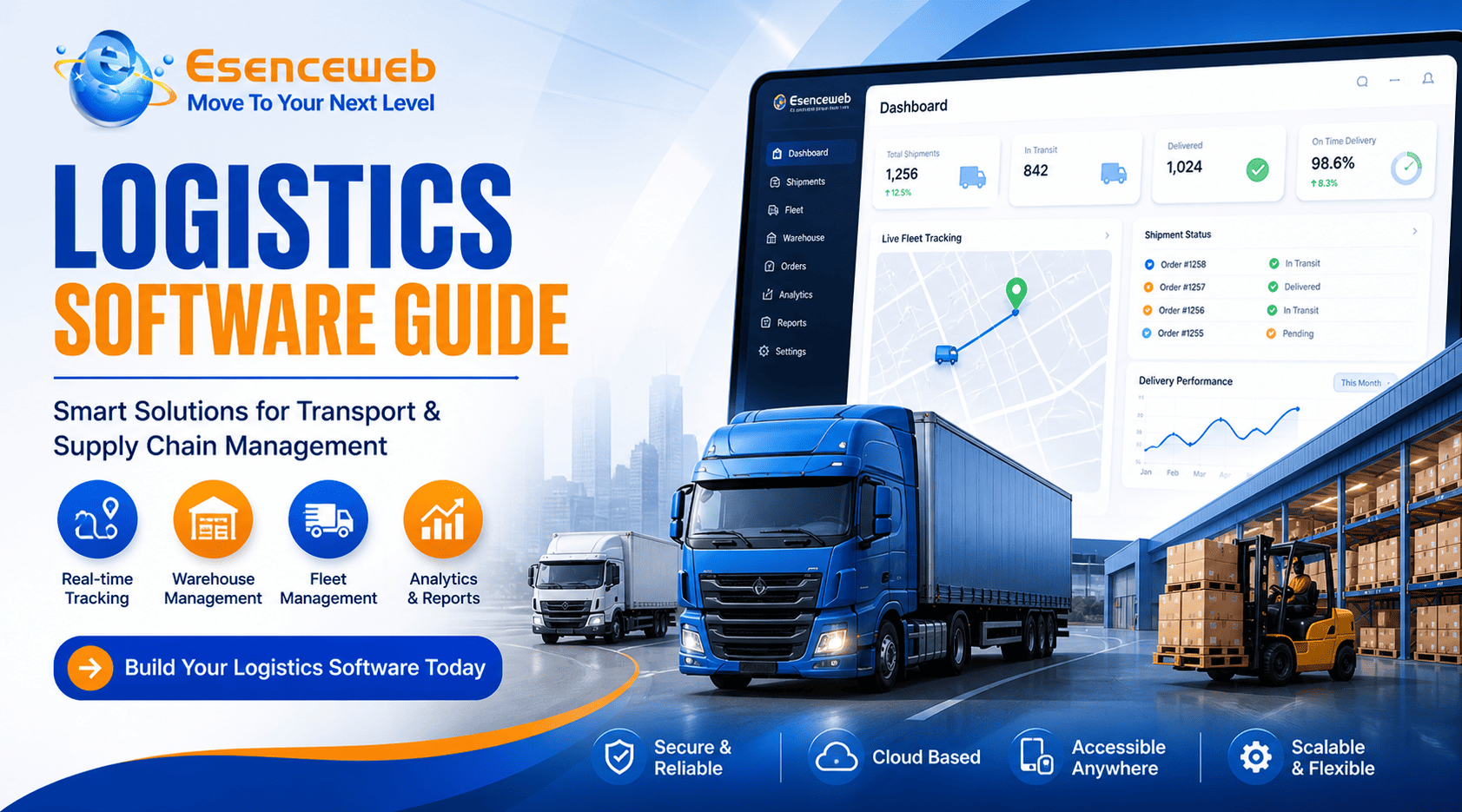
Logistics companies coordinate vehicles, drivers, shipments, delivery schedules, customer communication and billing. A customized logistics management system can bring these activities into a centralized application.
Potential functionality includes:
- Vehicle and driver management
- Shipment and delivery status
- Route planning and tracking integrations
- Trip and freight management
- Customer notifications
- Freight billing and operational reports
Custom Warehouse Management Software
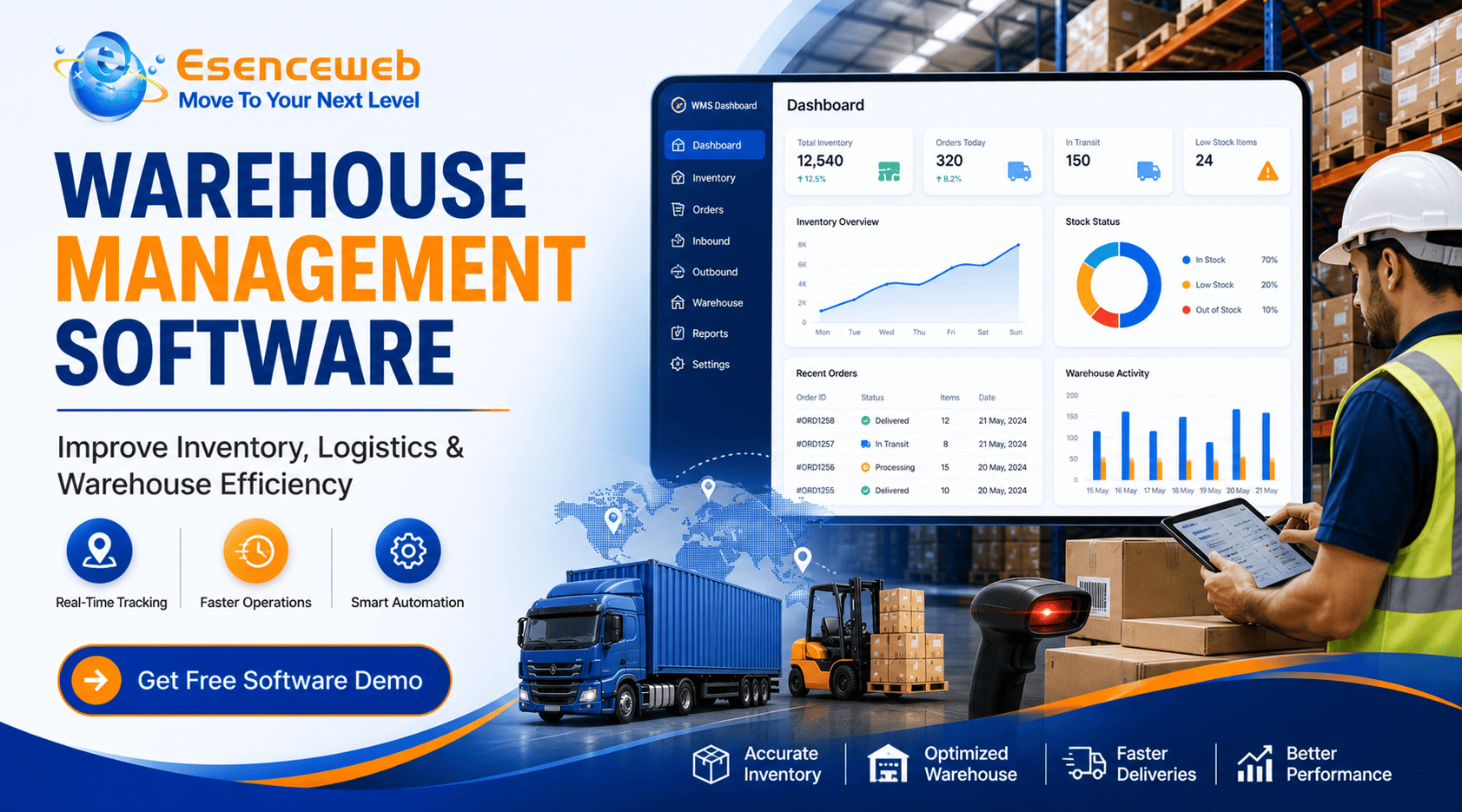
Warehouses may require more than basic stock records. Warehouse management software can be designed for goods receipt, put-away, bin locations, barcode scanning, picking, packing, dispatch and stock transfers.
The right workflow depends on warehouse size, SKU volume, transaction frequency, equipment and existing ERP or accounting integrations.
Custom CRM Software Development
Businesses with active sales teams may need a CRM system tailored to their lead generation, follow-up and customer management process.
Possible CRM features include:
- Lead capture and assignment
- Customer and contact records
- Follow-up scheduling
- Sales pipeline management
- Quotation and task tracking
- Customer activity history
- Sales team dashboards
Custom ERP Software Development
Organizations managing several departments may benefit from an ERP platform that connects sales, purchasing, inventory, finance-related workflows, HR and reporting. The scope should reflect the organization's processes and its existing accounting or ERP environment.
Custom ERP development can be particularly relevant when standard systems cannot accommodate essential operational requirements without excessive workarounds.
Custom Software for Retailers, Distributors and SMEs
Retailers and distributors may require multi-counter sales, customer credit records, billing, payment reconciliation, purchase tracking, branch reporting or dealer-specific pricing. Custom business applications can be structured around these requirements without adding unrelated modules.
For small and medium-sized businesses, a phased implementation may be practical: start with the highest-priority workflows and add further modules when the business case supports them.
How Much Does Custom Business Software Development Cost in India?
The cost of custom software development in India varies according to the project's scope and complexity. There is no reliable universal price that applies to every business application.
Important cost factors include:
- Number and complexity of modules
- Number of user roles and approval levels
- UI/UX design and responsive requirements
- Web, Android or iOS development
- API and third-party integrations
- Database structure and data migration
- Security, audit and compliance requirements
- Reports, dashboards and analytics
- Testing, deployment and documentation
- Hosting, backups, support and maintenance
A focused internal workflow application can have a very different scope from a multi-branch ERP, logistics platform or integrated warehouse management system.
How to Plan Your Software Development Budget
- List the business problems the application must solve.
- Identify essential modules and user roles.
- Document integrations and data migration needs.
- Separate launch requirements from future enhancements.
- Request a documented scope, timeline and cost breakdown.
- Clarify hosting, third-party fees, maintenance and support.
Compare quotations by deliverables, implementation approach, security, testing, documentation and ongoing costs rather than selecting a vendor on price alone.
Explore our custom software development services to discuss a solution based on your business requirements.
How to Choose a Custom Software Development Company
Selecting a software development partner is an important business decision. The quality of requirement analysis, architecture, implementation and support can influence the usefulness of the final system.
1. Evaluate Relevant Project Experience
Ask whether the team has experience with comparable workflows, integrations or industry requirements. Review relevant case studies and demonstrations where available.
2. Check Technical Capabilities
Evaluate the team's experience in frontend development, backend systems, databases, APIs, testing, deployment and mobile development where applicable.
3. Confirm Business Understanding
A capable partner should ask about current processes, pain points, users, exceptions and expected outcomes before recommending a solution.
4. Request a Clearly Defined Scope
Confirm included modules, deliverables, integrations, assumptions, exclusions, acceptance criteria and change-request procedures in writing.
5. Discuss Security and Data Access
Ask about authentication, role-based permissions, backups, audit logs, deployment security and vulnerability management.
6. Clarify Ownership and Maintenance
Review source-code access, intellectual property terms, documentation, hosting responsibilities, support hours, bug-fixing arrangements and future enhancement charges.
7. Evaluate Communication and Testing
Look for a practical project communication process, demonstrations, milestone reviews and a documented testing and acceptance procedure.
Why Consider a Custom Software Development Company in Pune?
Businesses in Pune and across Maharashtra operate in manufacturing, logistics, education, healthcare, retail, distribution and professional services. Their software requirements can range from simple workflow automation to integrated enterprise applications.
Working with a local development partner may make requirements meetings, project demonstrations and ongoing communication more convenient for Pune-based organizations.
Location alone does not establish a company's suitability. Evaluate its technical capabilities, project experience, development process, communication, security practices and post-launch support before making a decision.
Custom Business Software Development at Esenceweb
At Esenceweb Software Company, we specialize in custom software development, business web applications, mobile applications, ERP, CRM, ecommerce and workflow automation solutions designed around business requirements.
We focus on understanding the operational challenge, defining the required functionality and planning a solution that fits the business rather than adding unnecessary complexity.
Depending on your project, the proposed solution may include:
- Business requirement analysis and workflow planning
- Custom web application development
- REST API and database development
- Custom ERP and CRM systems
- Inventory and warehouse management software
- Logistics and operational management applications
- Ecommerce and customer-facing portals
- Mobile-friendly business applications
- Third-party integrations and business dashboards
- Testing, deployment and agreed maintenance services
Whether you are replacing spreadsheets, connecting disconnected applications or planning a new business platform, the first step is to define the problem, priorities and expected outcome.
Looking for Custom Software Development in Pune?
Tell us about your business process, required modules, users and integration needs. Our team can discuss a suitable development approach and project scope.
Esenceweb Software Company
Custom business applications for companies in Pune
and across India.
Our Custom Software Development Process
Step 1: Business Discussion
Understand the current workflow, operational challenges, user requirements and business objectives.
Step 2: Requirement Analysis
Document modules, user permissions, business rules, reports, integrations and project boundaries.
Step 3: UI/UX and Technical Planning
Plan the interface, database, application architecture and implementation milestones.
Step 4: Development
Develop the agreed modules and integrate the required business workflows.
Step 5: Testing and Review
Validate functionality, permissions, data handling, integrations and relevant device compatibility.
Step 6: Deployment
Deploy the application to the agreed hosting or cloud environment and configure the required access.
Step 7: Support and Enhancements
Follow the agreed maintenance plan, resolve covered issues and plan additional functionality when required.
How to Measure the Business Value of Custom Software
Before development begins, define how success will be evaluated. Clear measurements help management determine whether the software is solving the intended problem.
Depending on the project, useful indicators may include:
- Time required to complete a business transaction
- Number of manual steps in a workflow
- Frequency of duplicate or incorrect records
- Time required to prepare management reports
- Order processing and delivery turnaround
- Inventory record accuracy
- Response time for customer enquiries
- Adoption of the new system by employees
Record a baseline before implementation and compare results after the system has been adopted. Benefits will depend on the business process, software quality, staff training and how consistently the application is used.
Frequently Asked Questions About Custom Business Software
What is custom business software?
Custom business software is an application developed around an organization's specific processes, users, business rules and operational requirements.
What are the main benefits of custom software?
Potential benefits include workflow automation, centralized information, tailored functionality, integrations, improved reporting, controlled access and support for business growth.
Is custom software better than ready-made software?
Not always. Ready-made software may be more practical when its standard features meet your requirements. Custom development is worth considering when important workflows, integrations or reports cannot be handled effectively by existing products.
Is custom software suitable for small businesses?
Yes, when the business has a clear need that existing software does not adequately address. A focused initial scope can help control investment and avoid unnecessary functionality.
How much does custom software development cost in India?
The price depends on modules, platforms, integrations, design, security, testing and deployment requirements. A documented requirement analysis is needed for a meaningful project estimate.
How long does custom software development take?
Timelines vary according to functionality, complexity, integrations, feedback cycles and testing requirements. The development company should provide an estimated timeline after reviewing the project scope.
Can custom software integrate with existing applications?
Yes, where suitable integration methods or APIs are available. The feasibility depends on the existing system, provider permissions, licensing, data formats and security requirements.
Can custom business software work on mobile devices?
Yes. It can be developed as a responsive web application or as a dedicated Android or iOS application, depending on the required user experience and device functionality.
What is the difference between custom ERP and CRM software?
CRM software primarily supports customer relationships, leads and sales activities. ERP software connects broader business functions such as purchasing, inventory, finance-related workflows and operations. Some businesses need both systems or integrations between them.
How do I choose a custom software development company in Pune?
Evaluate relevant experience, technical skills, requirement analysis, documented scope, security, pricing transparency, testing, communication and post-launch support.
Final Thoughts: Is Custom Business Software Right for Your Company?
Custom business software is not simply another IT expense. When it addresses a clearly defined business problem, it can become an important part of the organization's operational infrastructure.
The right application can help connect departments, automate repetitive activities, organize business data, improve reporting and support new requirements as the company grows. Its value depends on careful planning, implementation, employee adoption and ongoing maintenance.
If your business is struggling with manual processes, disconnected applications, inventory challenges, reporting limitations or specialized workflows, consider whether a customized digital solution could improve the way your organization operates.
Planning a custom business software project in Pune or elsewhere in India? Contact Esenceweb Software Company to discuss your business requirements, project scope and suitable development options.





.png)

0 Replies to “Benefits Of Custom Business Software | Pune Software Company”
Leave a Reply
Your email address will not be published.